Blog
How to Keep Monsoon Dust Out of Your Mesa Home
Monsoon season in the Valley runs June 15 to September 30, and somewhere in that stretch a wall of brown will roll up from the south and swallow Mesa for an hour. When it clears, the dust is inside.
On the sills, on the entry tile, in the tracks of every sliding door, on the top of the fridge. Day Cleaning Solutions cleans houses across the East Valley through every one of these storms, and this is how we tell people to get ahead of it.
None of this needs special equipment. It needs a little timing, a few habits, and a realistic idea of what a stucco house with track windows can and cannot keep out.
What a haboob does to a house
A haboob is a dust storm pushed ahead of a thunderstorm's outflow. The wind comes first and carries the finest desert grit with it, the kind that hangs in the air long after the wall has passed. That grit does not need an open window. It finds the gap under the garage door, the weep holes in the window frames, the gap where the sliding door meets its track, the seam around the laundry exhaust, and the place where the front door weatherstrip has flattened over the years.
Older Mesa homes with single-pane track windows and original weatherstripping take the most. Newer builds do better, but the sliding patio door is the weak point in almost every house we clean, because the track cannot seal against the fine stuff. Add a pool deck or decomposed granite in the yard and the grit has a staging area a few feet from the door.
Before the storm: shut, stage, and pull things in
The weather service usually gives some warning, and the sky gives more. When the horizon goes tan, do these in order.
Close every window and lock it. A locked window pulls tighter into its frame than a closed one. Slide the patio door shut and drop the security bar so it cannot walk open in a gust. Shut the garage door and, if you have one, the door from the garage into the house. Turn the thermostat fan to auto rather than on, so the system is not pulling outdoor air harder than it has to.
Pull the patio furniture cushions in or they will be gritty for a week. Bring in anything with fabric. Then leave it alone. There is no point wiping a sill while the storm is still coming.
During the storm: leave the windows alone
People go around cracking windows to "equalize" or opening the door to look. Every one of those opens a path. Keep everything shut until the air has visibly cleared, and then give it another half hour, because the fine dust that hangs after the wall passes is what gets inside.
If the power flickers, do not run the vacuum right away when it comes back. Let the dust settle. Vacuuming a room where dust is still airborne just moves it around.
The first hour after: doors, tracks, and floors
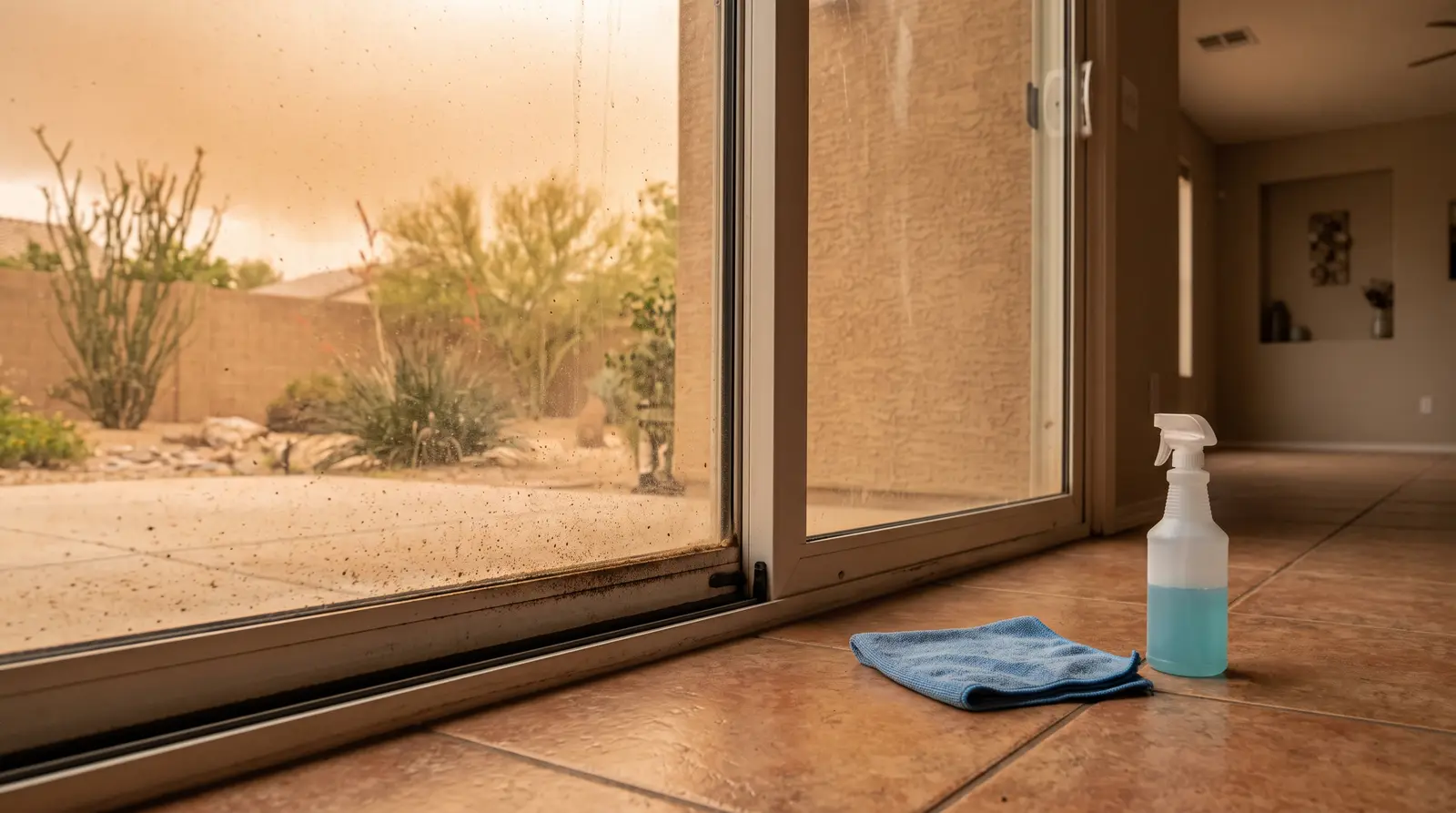
Start at the entries, because that is where the concentration is. Wipe the door thresholds and the sliding door track with a damp microfiber cloth, not a dry one. A dry cloth or a feather duster lifts the dust into the air again; a damp microfiber holds it. Rinse the cloth often. You will be surprised how many times it comes up brown.
Do the window sills next, then the tile near the doors. Vacuum before you mop. A vacuum with a HEPA filter traps the fine particles instead of blowing them back out through the exhaust, which matters more in a dust storm week than any other week of the year. Mop the tile afterward with clean water changed as it goes gray. If you mop first, you are just making mud in the grout lines.
Then wipe the horizontal surfaces at eye level and above: the top of the fridge, the top of the door frames, the ceiling fan blades if you can reach them safely. The dust settles from the top down and you want to catch it before it drifts.
The week after: what you did not see land
A haboob leaves a second layer that shows up over the following days as the air in the house circulates. It lands on the blinds, on the baseboards, on picture frames and on the return air grille. This is the part most people miss and the part we see on a first visit: a house that was wiped down the day after the storm and still has gray on the baseboards a week later.
Change or check the HVAC filter after a big storm; it has been doing the heavy lifting. Run a damp microfiber along the baseboards in the rooms nearest the doors. Pull the vent covers in the bathroom and wipe them. Vacuum the blinds with the brush attachment or wipe each slat.
We can tell from the front door how a house rode out a storm: grit in the threshold groove and a film on the entry tile means the seal gave a little, and that is where we start every post-storm clean.
Getting through the whole season
One storm is a chore. A season of them is a schedule. This is where a recurring house cleaning on a weekly or every-two-weeks rhythm earns its keep in Mesa: the tracks, sills, baseboards and tile near the doors get done on a cadence that matches how fast the dust comes in, instead of building up until it is a project.
If the house has never had a real reset, or the last storm caught you with the patio door open, a deep cleaning first gets the blinds, the fan blades, the tops of the cabinets and the grout back to a baseline, and then the recurring visits keep it there. We bring our own supplies, including microfiber and a HEPA vacuum, and we work the house from the doors inward the same way this post describes. You can see what other Mesa homeowners have asked about on our Mesa page, and more seasonal reading on the blog.
Frequently Asked Questions
Not right away. The finest dust hangs in the air for a while after the wall passes, and opening up too soon pulls it in. Wait until the air outside is clearly back to normal, then a short airing is fine if the temperature allows, which in July it usually does not.
A damp microfiber cloth is better. Dry dusters lift the fine particles back into the air where they settle again somewhere else. Microfiber grabs and holds, and rinsing the cloth as you go keeps you from pushing the same grit around.
Because the first pass gets what landed and the house's air keeps circulating what is still suspended, plus whatever is sitting in the return grille and on the fan blades. A second pass on the baseboards, blinds and vents a few days later gets the rest.
We start at the doors and tracks with damp microfiber, vacuum with a HEPA filter before we mop, and work from the high surfaces down. If the storm was a big one we tell you what we found at the seals so you know where the house is letting it in.